
After three decades tackling drug crime from South Wales to the Caribbean, Detective Sergeant Richard Gregory describes retirement as a pivot in his career rather than an end to it.
Richard, who is known as Dick, retired from South Wales Police in February.
And he has since launched a consultancy which aims to train the next generation of police officers and drug enforcers.
He said: “I want to give something back and pass on the drug enforcement knowledge and experience I’ve built up over 30 years.
“I want to teach the younger officers about the mistakes I made when I was in their position and what the current challenges are in drug policing.”
Dick had worked in a family bakery before joining South Wales Police as a 22-year-old in 1996.
He said: “I joke that when I used to weigh out the flour in grams and ounces, it obviously put me in good stead for dealing with drug crime.”
Dick was following in the footsteps of his dad, Richard, also known as Big Dick Gregory. His dad was also a detective and was also involved in drug enforcement until his retirement in 2009.
Dick started on response in Barry for 18 months, and quickly gravitated toward plain-clothes policing and drug enforcement, joining the then Priority Policing Teams.
“We had a free run at the problem criminals,” he said. “That’s where I got a real feel for drugs work.”
County lines
By the early 2000s, he was already encountering what would later be labelled county lines, organised networks moving drugs across regions.
He said: “I remember in 2001 investigating boys from London sent into Barry to deal drugs for a criminal network.
“They used to use phone boxes for delivering the drugs.
“The term county lines has come to be used in the past 10 or 15 years, but it’s not new, it’s just been rebranded.”
His expertise grew through specialist training and courtroom experience, becoming a drug liaison officer and expert witness.
International investigation
In a 30 year career, one case stands above the rest.
In 2006, Dick led an investigation into the death of a woman who had smuggled cocaine from Trinidad to the UK in her stomach. She died after falling ill while attempting to pass the drugs.
After identifying a second person, who was from Barry, as being involved, the case took him to Trinidad, retracing their steps with support from national agencies.
He recalled: “There were lots of lines of inquiry and lots of doors that were open that needed to be shut with regard to what happened in Trinidad.
“We had to walk in their footsteps, from when they landed, where they visited, all the witnesses. We had to get all those missing pieces of the jigsaw.”
Trial and convictions
The evidence gathered led to a five-week trial and convictions, with two offenders sentenced to 14 and 10 years for importing cocaine.
“I think that was my biggest achievement,” he said. “Working outside UK jurisdiction and being able to get a successful prosecution.”
Promoted to detective sergeant around 2009–10, Dick moved into leadership roles, including managing prisoner handling units and later heading dedicated drugs teams.
His work increasingly focused not just on enforcement but on developing others.
“I had a lot of young officers coming through,” he says. “It was about giving them the experience to move into specialist roles.”
Shaping policing practice
Dick also played a national role in shaping policing practice.
He contributed to training through the National Police Chiefs’ Council (NPCC), and he helped establish DEWVA (Drugs Expert Witness Evaluation Association).
DEWVA now has more than 1,100 members and seeks to encourage professional development, promote perspective, knowledge, best practice, and provide networking opportunities for law enforcement drug expert witnesses
Dick, who was chair of DEWVA from 2018 to 2024, said “We give expert witnesses within drugs law enforcement credibility when they’re in court and helps to safeguard investigations.”
In the last four years of his career, Dick was tasked with improving standards and speeding up delays in investigations.
Training programmes
He developed training programmes that brought together police, forensic experts, and CPS lawyers.
“I was able to get those speakers in, to speak to those young officers so they understand, it’s a prosecution team,” he said. “We’ve all got to work together.
“It’s building that understanding of the process in the criminal justice system, and it gives the officers a lot more confidence.
Dick admitted that he “loved every minute” of his service.
And he said his approach, which involved being able to talk to suspects on their level, as a key to his success.
“To catch a criminal, you’ve got to understand how they think and you’ve also got to be able to talk to them as well on their level,” he said.
Admit offences
“Speak to them as you expect to be spoken to and often they admit the offence a lot quicker.”
Dick said that policing has changed considerably over his career. Criminal methods have evolved with technology, forcing officers to continually adapt and learn.
“We’re always playing catch-up,” he said, pointing to developments such as encrypted communications and emerging technologies.
At the same time, he believes the structure of policing has shifted.
“Years ago, officers would double or triple hat and deal with everything,” he said. “Now there are so many specialist departments.
“That’s one of the biggest changes and maybe we’ve thinned it out too much.”
Training
Dick’s attention has now turned to his consultancy work and he already has his first bookings, with forces seeking his expertise in training and drug investigations.
“It’s exciting,” he said, “I went into policing as a baker, and I’ve come out able to set up my own business and share what I’ve learned.”
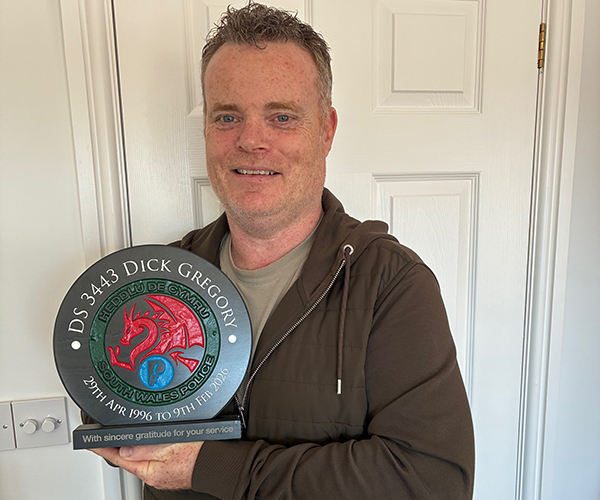
To mark his retirement, Dick received a special commemorative slate through the South Wales Group Insurance Scheme (GIS) and was presented by the Federation.
“It’s one of the best leaving gifts I’ve had,” he says. “It really means a lot to me.
“It goes very well by my log burner in my back room and has pride of place there.”
Retirement plaque for GIS members
The brand-new retirement plaque was introduced for members of the South Wales Group Insurance Scheme (GIS) and launched on 1 January 2026. This bespoke Welsh slate memento has been carefully designed to recognise the dedication, service, and commitment of both officers and staff across all roles within South Wales Police.
Crafted in partnership with The Slate House, the plaque uses authentic Welsh slate – chosen for its strong cultural significance and its symbolism of strength, resilience, and longevity. Each piece is intended to serve as a lasting tribute, marking the transition from a policing career into retirement while sitting alongside traditional honours such as long service medals.
The initiative reflects a shift in how service is recognised, acknowledging that modern policing careers are evolving and that valuable contributions are not defined solely by reaching historic milestones.
Who is eligible?
- Police staff and police officers across all ranks, roles, and departments within South Wales Police
- Recipients must be GIS members and have completed at least 20 years of service
- Recipients must have been part of the GIS for a minimum of five years.
The plaque is available to anyone retiring after 1 January 2026. However, due to increased interest, plaques can also be purchased by those who retired before this date at a reduced cost of £80.
If you are not already a member of the GIS and would like more information on joining, then visit the GIS page on our website.
If you know someone – of any rank, role or department – who is eligible for a retirement slate, or you want more information on the plaque, including how to purchase one as a retired member, please contact the South Wales Police Federation office.