
A detective inspector is currently on track to run 100km in May, raising funds for a baby loss charity, having experienced two miscarriages himself.
Richard ‘Reggie’ George, who has been serving with South Wales Police for 22 years, is taking on the challenge for Sands, a national charity that supports families who have experienced baby loss.
His fundraising efforts come after he and his wife, Sarah, experienced two miscarriages, not long after they married.
“At the time, I was 25,” recalled Reggie, who is now 45. He added: “You get that positive pregnancy test and you don’t think about anything else. You can’t even prepare yourself for someone telling you the baby hasn’t developed.”
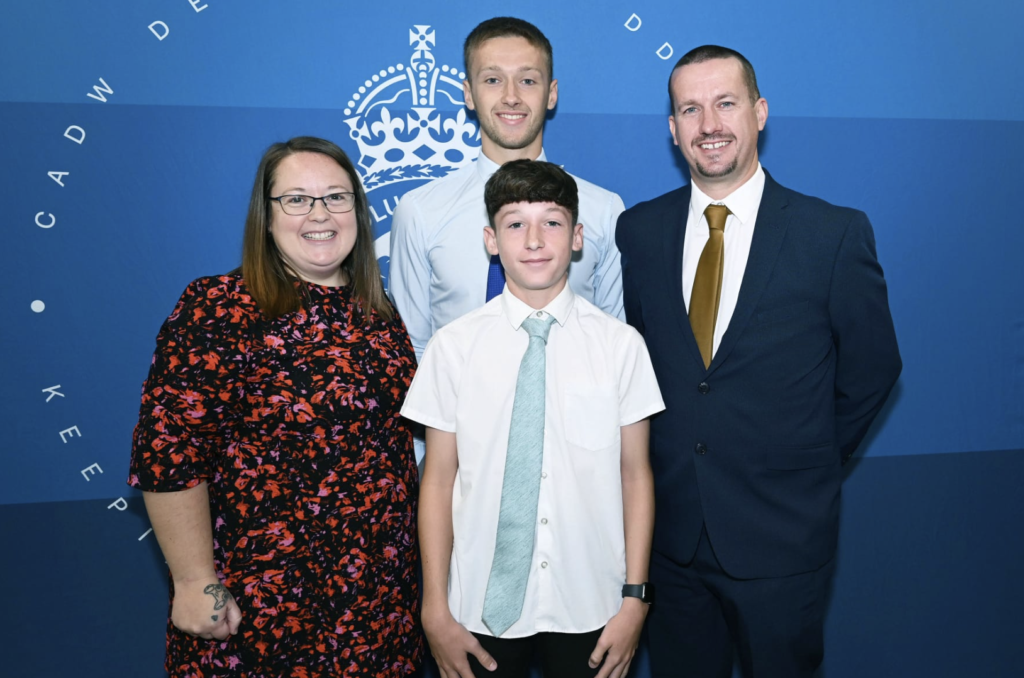
Reggie (right), with his wife Sarah and their two children, Ceiron and Ioan
At their 10-week scan, there was no heartbeat.
“Sarah was distraught, and I think I was just numb,” he says. “Our parents – the baby’s grandparents – were devastated too.”
The support, he remembers, centred almost entirely around his wife – understandably so – but little attention was given to how he was coping.
“I think men can be forgotten about sometimes, following a miscarriage,” continued Reggie.
Helpless
“Even for me, because I wasn’t physically experiencing the miscarriage, Sarah was the priority. You feel completely helpless. What can you say to make it better?
“I went back to work the next day, I just cracked on with it.”
Reggie said he returned straight back to shift work and deliberately avoided conversations about what had happened.
He added: “I remember telling colleagues I didn’t want to talk about it. At the time, you don’t realise the impact it has on you.”
The experience itself was traumatic. Sarah underwent a medical procedure to remove the fetus.
“It was horrible,” Reggie said. “Being on the maternity ward, everything felt very matter-of-fact. I know for staff it’s routine, but for you it’s the worst thing happening in your world.”
A second miscarriage followed months later, but this time at home.
“That one was hard because you start second-guessing everything,” he said, adding: “You blame yourselves and wonder what you’ve done wrong.”
Medical advice
Following the second loss, the couple sought private medical advice to see if there was an underlying issue, but no explanation was ever found.
“At that point, we’d almost given up,” Reggie said. “We rescued a dog through work and booked a holiday.”
Three months later, Sarah became pregnant again – this time successfully. Their eldest, Ceiron, is now 19, while their younger son Ioan is 16.
Reggie knows how fortunate they were. He also knows many families do not get the answers – or the outcome – they desperately hope for.
“You can’t help but think you’re on your own – but sharing does take some of the weight off.
And looking back now, he recognises how much he bottled up emotionally.
“After having counselling for something unrelated later in life, I realised I shouldn’t have kept it all inside,” he said. “It’s like a scab waiting to be picked off.”
At the time, he says, peer support groups for baby loss were far less visible, particularly for men. Organisations such as Sands are helping to change that conversation today.
Still, he believes stigma remains, especially among men and in policing.
Stigma
“There’s this feeling that we’re supposed to be protectors,” he said, adding: “Especially for male officers, there’s still a real stigma.”
That is why he now tries to speak openly and reach out to others who may be struggling in silence.
“I tell people I’ve been there,” he says. “But you can’t support others if you’re crumbling inside.”
For Reggie, sharing experiences matters because baby loss can leave parents feeling isolated.
“You can’t help but think you’re on your own,” he says. “But sharing does take some of the weight off. This is happening too often for people to suffer alone.”
The 100km challenge has become part of that healing, too. And already 55km in, Reggie says the experience has become about far more than exercise.
Comfort
“It’s quality time with my son as well,” he explained. “We’re all chained to our laptops and caught up in the grind of daily life. It’s about stepping away from that and trying to build better habits long term.”
“It’s mentally challenging as well as physically challenging. But there’s already been an improvement. My pace is getting better, and I’m trying to do something every other day.”
More importantly, it has reinforced something he wishes he had understood years ago.
“My advice to others is reach out,” he said, ending: “Talk to people. Shared experiences are massive. Not everyone understands, but knowing somebody else has been through it can bring real comfort.”
South Wales Police has a Baby Loss Peer Support Group, which is made up of volunteers who have received training from Sands.
Information, guidance and links are available on the Force intranet or e-mail BabyLossPeerSG@south-wales.police.uk