
After more than two decades with South Wales Police, Detective Constable Phil Pitchforth has built a career he loves, a marriage he’s proud of, and a family he once wasn’t sure would be possible.
By speaking openly, he hopes that someone else might feel just a little more comfortable in their own skin.
“I understand that worry,” said the 44-year-old. “I’ve been there. But it’s OK to be you.”
When Phil joined policing in 2004, he didn’t step straight into a warrant card. Instead, he began as a traffic warden, a role he loved – much to his surprise.
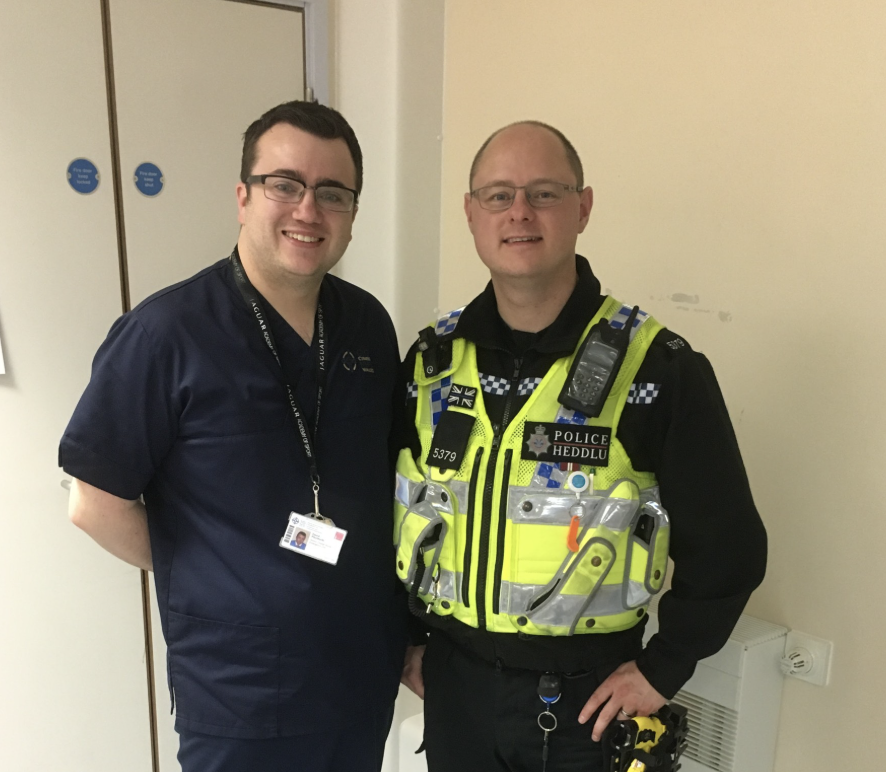
Phil (right) and husband Dave
“I always wanted to be a police officer,” he says. “But I’m dyslexic, and I initially struggled to become a regular. When the traffic warden opportunity came up, I applied and got in. I was just grateful to be part of the Force in some way.”
Brought up in the Christian faith, he developed an early desire to serve. For a time, he imagined becoming a priest in the army. But by the age of 12, he knew policing was his path.
“It felt exciting, but more than that, it was about giving something back,” he continued, adding: “That’s always been important to me.”
Personal journey
He moved from traffic warden to becoming one of the force’s first PCSOs, working in Bridgend and later Cardiff. In 2012, he achieved his goal of becoming a police constable. Since then, he has worked across a variety of departments, including safeguarding, public protection, and, in 2019, the child investigation unit — a role that would later shape his life.
Alongside his professional journey ran a deeply personal one. When Phil first joined policing, he wasn’t open about being gay.
“I worried about what people would think,” he says. “In the 1990s, my perception of the police was that they wouldn’t be as accepting as they actually were.”
When the force launched its first-ever gay staff network, Phil began to realise something important: it was OK to be open. Gradually, he started to be honest with his colleagues.
Work husband
One of those colleagues is Detective Constable Dave Watkins – affectionately known as his ‘work husband’.
The two first started working together in 2016 on the Priority Policing Team. Since then, as Phil joked, Dave has ‘followed him around’, with the pair working side by side on the Organised Crime Team and now within the IOM team.
“I’m the Robin to his Batman,” Phil said.
But the friendship goes far beyond the day job. Dave Watkins and his wife Nikki, became close family friends to Phil and his husband, Dave. Their bond was cemented in the most meaningful way when they became godparents to Phil and Dave’s son, Charlie, at his christening.

Phil, Dave and their son, Charlie
“It means a lot,” Phil said, adding: “They’re not just colleagues – they’re part of our family.”
That same sense of friendship and support stretches back to his wedding day. Phil’s best man was PC Merb Hussain, his Neighbourhood Beat Manager at the time. Phil remembers being incredibly nervous about telling him he was gay when they first began working together.
When Phil did finally open up, his fears quickly disappeared. Looking back, he said he now realises how unnecessary those early fears were.
“The worry was always worse than the reality,” he reflected. “The support has always been there.”
Confetti
Phil first met his future husband, Dave, in 2008, while working as a PCSO.
“We hit it off straight away,” Phil recalled. They moved in together in 2009 and married in 2011 at Cardiff’s City Hall.
“It wasn’t elaborate – we didn’t have much money – but it was brilliant. Colleagues who couldn’t get the day off still came in uniform to throw confetti. It meant everything.”
Phil became a police officer the following year. Meanwhile, Dave, a qualified nurse, began working in A&E. Today, he is Head of Nursing within the Cwm Taf Morgannwg network – the ‘high flier’ of the two, as Phil affectionately puts it.
They still cross paths professionally – nurse and police officer – both committed to caring for their communities in different ways.
In 2019, Phil moved into the child abuse investigation unit.
“Professionally, I hated it,” he admitted. “It was incredibly tough. But it changed me.”
Seeing firsthand how many children were in desperate need of safe, loving homes transformed his views on adoption. Dave had always been keen to have children, while Phil had been more cautious, aware of the perceived stigma around same-sex adoption.
Families
He said: “The job opened my eyes. It made me realise just how many children need families.”
They began the process in 2019. It took two years – right through the heart of COVID – before they were finally placed with their son in 2021.
“I had no clue what I was doing, and we couldn’t go anywhere because of COVID – the only thing we could do was go to the park. It was hard. But it was worth it.
“It was the most amazing and important thing I’ve ever done in my life.
“My biggest fear was that he wouldn’t bond with us – or we wouldn’t bond with him. But within minutes, he just fitted in.”
Their son is now six, and their journey, Phil says, is still incredible.
Phil considers himself exceptionally lucky. When he came out to his mum in 1999, she laughed – she had known all along. His twin brother came out at the same time. Acceptance, in his personal life, was immediate.
Seek advice
He said: “I can’t recall experiencing any negative experiences as a result of my sexuality. It was more the worry about telling people. I know I’m lucky, though – and not everyone has the same positive experiences as me.”
Over the years, the force’s LGBT+ network evolved but has always remained a community to seek advice, share experiences and know you’re not alone.
When he and Dave adopted, that support extended into practical help. His inspector at the time was the force’s adoption champion, and flexible working arrangements made family life manageable. Phil said that encouragement and understanding were never in short supply.
More than 20 years after joining policing, Phil still feels lucky to be in a job he loves.
“I get to do something I’ve always wanted to do. I still enjoy it now,” added Phil, who said he has seen how much culture has changed – and how important visibility and support networks are.
And that’s exactly why he’s telling his story now.
He ended: “It’s OK to be you. And if sharing this helps even one person feel more confident about who they are – then it’s worth it.”
READ MORE….stories like this in our new Federation magazine.